
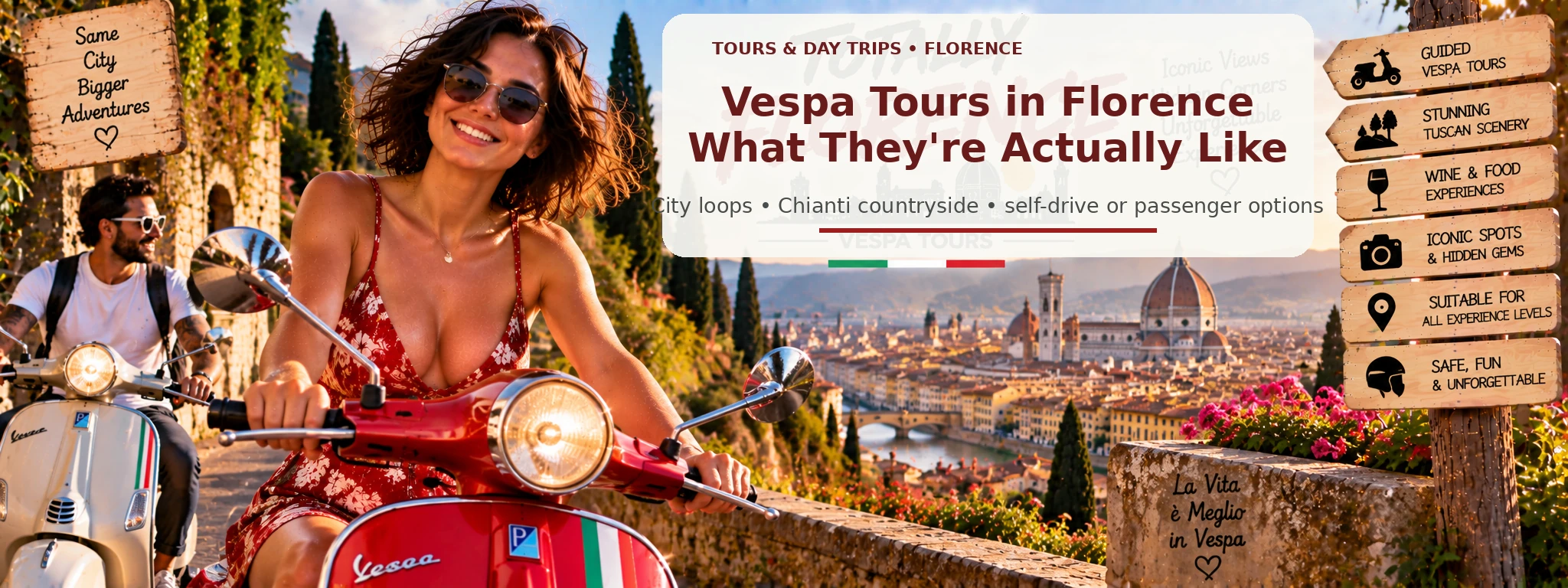
A Vespa tour is one of those Florence ideas that can either be brilliant or stressful, depending on how comfortable you are on two wheels. The appeal is obvious: you leave the dense historic centre behind, climb through olive-covered hills and reach viewpoints, villas and Chianti roads that are awkward to stitch together by public transport. The important bit is choosing the right format for your riding ability rather than booking the most photogenic option.
Choose the format before the route
Most experiences fall into three broad types. On a self-drive guided tour, you ride your own scooter while following a guide. On a passenger or chauffeured tour, somebody else handles the scooter and you ride behind them or in a sidecar. A third option is a small-group countryside excursion that combines scooters with lunch, a farm or winery visit. If you have limited riding experience, the passenger format is usually the sensible choice; Florence traffic, cobbles, steep junctions and fast-moving suburban roads are a poor place to learn.
Licence, insurance and operator checks
Do not assume that a normal car licence automatically covers every scooter used on a tour. Eligibility depends on the scooter's engine category and on the licence you hold, and rental companies can impose stricter conditions than the legal minimum. Before paying, ask the operator in writing what licence is required, whether an International Driving Permit is expected for your nationality, what insurance excess applies, and whether damage to tyres, mirrors and underbody parts is excluded.
A legitimate operator should also brief you on the controls, provide a correctly fitting helmet, explain the route and give you a chance to demonstrate that you can start, stop and turn confidently. If the briefing feels rushed or you are clearly uncomfortable, switch to a passenger option rather than treating the first kilometre as practice.
Florence traffic is not the postcard
The classic image is a quiet cypress road, but many tours begin or end in ordinary urban traffic. Florence has restricted-traffic and pedestrian areas, camera-controlled access points and special rules around certain streets. Some two-wheel access is permitted where cars are restricted, but not everywhere, and specific pedestrian zones such as the Bardi/Pitti area require authorisation for certain motorcycles and mopeds. The safe approach is to follow the operator's route rather than improvising through the centre. Florence's road-management authority also maintains current ZTL and parking information, which is worth checking if you are renting independently rather than joining a guided tour.
City tour or Chianti countryside?
- Short city-and-viewpoint routes suit travellers with limited time. They often focus on the hills south of the Arno, panoramic stops and roads around Piazzale Michelangelo rather than prolonged riding inside the pedestrian core.
- Half-day countryside routes are the sweet spot for most visitors. You get enough open-road time to understand the appeal without turning the day into an endurance ride.
- Full-day Chianti tours work best for confident riders who genuinely enjoy being on a scooter for hours. Stops may include a village, farm lunch or winery, but the riding itself is a major part of the day.
If wine tasting is included, check how the operator handles riders who are driving. A good itinerary does not put guests in the position of drinking appreciably and then riding. If wine is the main priority, a driver-led Chianti day trip is usually a better fit.
What to wear and bring
Closed shoes, trousers or sturdy shorts and a light layer are much more comfortable than beachwear. Even in warm weather, exposed skin gets cold surprisingly quickly once you are moving outside the city. Sunglasses help, but they should fit comfortably with the helmet. Carry as little as possible: a small zipped bag is better than a loose tote, and anything hanging from your shoulders can become annoying on bends.
Weather matters more on a scooter than on a bus tour. Wet stone, painted road markings and metal covers become slippery, while hot summer afternoons can be exhausting in protective clothing. If rain is forecast, ask about cancellation or rescheduling terms before departure rather than hoping conditions improve once you are on the road.
How difficult is it?
For an experienced scooter or motorcycle rider, a guided Tuscan route is normally straightforward. For someone who has only ridden once or twice on holiday, it can be much harder than expected. Automatic transmission removes gear changes, but it does not remove balance, braking judgement, cornering or traffic awareness. Couples should also avoid assuming that carrying a passenger is as easy as riding solo; the extra weight changes low-speed handling.
When a Vespa tour is worth the money
It is worth paying for when the route gives you access to rural viewpoints, quieter roads and local stops you would not easily combine yourself. It is less compelling if the itinerary is mainly a slow loop through central traffic. Read the route description carefully and look for actual riding time, group size, fuel, helmet, insurance terms and what happens if you fail the pre-ride assessment.